
Not every asphalt repair requires cutting out and replacing the damaged area. Infrared asphalt repair heats and reworks the existing pavement, creating a smooth, durable finish that blends seamlessly with the surrounding surface.
What Is Infrared Asphalt Repair?
Infrared asphalt repair is a method used to fix localized pavement damage. It uses controlled infrared heat to soften the existing asphalt without placing a flame directly against the surface.
Once the asphalt becomes workable, a crew can rake the damaged section, remove failed material, and mix in a rejuvenating agent. Fresh asphalt may also be added to restore the proper grade and replace material that has been lost.
The repaired area is then compacted while it is still hot. This process joins the patch to the heated pavement around it, which helps limit the cold seams often left by other repair methods.
How Does Infrared Technology Heat Asphalt?
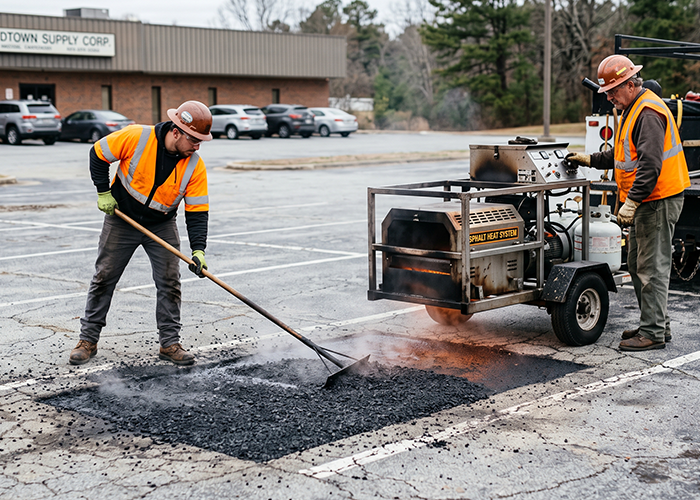
Infrared energy travels as electromagnetic radiation. When the asphalt absorbs this energy, the pavement’s temperature rises and its binder begins to soften.
The heating unit is suspended above the repair area. There is no direct flame touching the pavement. This matters because direct flames may overheat or burn the asphalt binder if they are not carefully controlled.
Heat must reach more than the top skin of the pavement. A surface that looks soft may still be cool and rigid below. Proper heating gives the crew enough workable depth to rake, mix, reshape, and compact the asphalt.
Heating time can change based on several conditions, including:
- The age and color of the pavement
- The type of asphalt mix
- The depth of the affected area
- The outdoor temperature
- Wind speed
- Moisture on or within the pavement
- The output and size of the heating unit
Older, faded asphalt may absorb heat differently from newer, darker pavement. Cold air and strong wind can also increase heating time because they draw warmth away from the surface.
Infrared equipment may look simple when it is sitting over a patch, but successful heating requires close attention. An experienced operator must know when the asphalt is warm enough to work without allowing it to overheat.
Why Is Infrared Heat Useful for Pavement Repair?
Asphalt is made from aggregate held together by a petroleum-based binder. As the pavement ages, that binder becomes harder and more brittle. Sunlight, oxygen, water, traffic, and temperature changes all contribute to this process.
Infrared heat temporarily softens the binder and makes the pavement workable again. The crew can then reshape the asphalt instead of immediately hauling all of it away.
This gives infrared repair one of its main advantages. The existing surface becomes part of the repair instead of being treated only as waste.
Heat also helps the old and new materials blend. When fresh asphalt is mixed with the softened pavement and compacted at the right temperature, the repair can form a close bond with the surrounding surface.
How Does the Infrared Asphalt Repair Process Work?
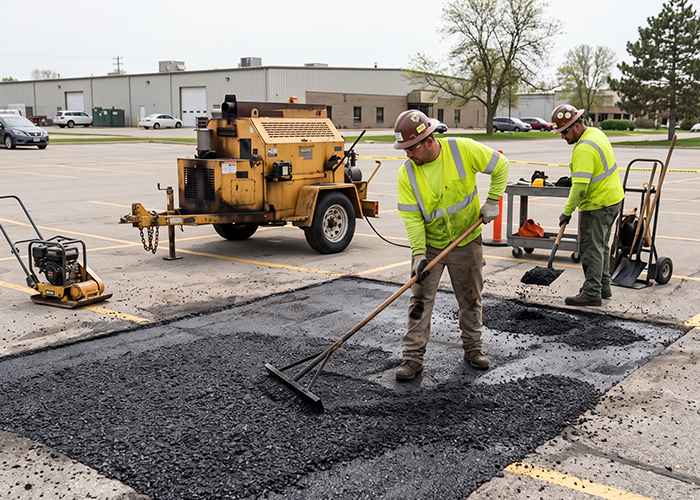
The exact repair process may vary by contractor, equipment, weather, and pavement condition. Still, most professional infrared repairs follow the same basic stages.
Inspecting the Damaged Area
Before work starts, the crew should determine why the pavement failed. A pothole caused by surface wear is different from a hole caused by a weak base, poor drainage, or an underground problem.
Infrared repair treats damage within the asphalt layer. It cannot rebuild a failed stone base or correct a serious drainage issue beneath the pavement.
The inspection helps the contractor decide whether infrared pavement patching is suitable. If the base remains stable, the repair may be a strong option. If the pavement moves under traffic or shows broad structural failure, deeper work may be needed.
Cleaning and Drying the Surface
Dirt, standing water, trash, and loose stones are removed before the heater is positioned. A clean surface allows heat to reach the asphalt more evenly.
Moisture can make the process harder to control. Some of the heat will be spent turning water into vapor instead of softening the pavement. Wet areas may also heat at different rates.
The repair should extend beyond the visible damage. Heating a larger border gives the crew enough material to blend the patch into pavement that is still in good condition.
Positioning the Infrared Heater
The infrared unit is placed above the damaged area. Its heating chamber should cover the defect and a portion of the surrounding surface.
The operator then starts the heating cycle and watches the pavement. Weather, asphalt age, and repair depth will affect how long the unit must remain in place.
The goal is not to scorch the surface. The goal is to soften a workable layer while preserving the binder and aggregate.
Raking the Heated Asphalt
After heating, the unit is moved away and the softened pavement is raked. Failed aggregate, dirt, and badly damaged material can now be removed.
The crew works the edges as well as the center. This helps eliminate weak spots and prepares the heated border for a close bond with the repaired area.
Raking also reveals whether the damage is deeper than expected. If a weak base or severe failure is found, the repair plan may need to change.
Applying a Rejuvenating Agent
Asphalt binder loses some of its lighter oils as it ages. A rejuvenating agent may be applied to help restore flexibility to the heated material.
This product should be used in the correct amount. Too little may not provide the desired effect, while too much can leave the asphalt soft or unstable.
The crew mixes the rejuvenator into the existing pavement rather than letting it sit in one spot. Even distribution helps create a consistent repair.
Adding Fresh Asphalt
Fresh hot-mix asphalt is added when the existing material is not enough to fill and grade the repair. The new mix replaces asphalt that was lost or removed during preparation.
It is blended with the heated pavement so that the two materials do not remain in separate layers. Careful mixing gives the repair a more uniform texture and structure.
The crew must also account for compaction. Loose asphalt sits higher than compacted material, so the repair may be slightly raised before rolling or tamping begins.
Grading and Compacting the Repair
The material is graded to match the surrounding pavement and support proper drainage. The crew must avoid creating a low spot where water can collect.
Compaction usually begins along the edges. This presses the heated border together and helps form a tight connection between the repair and the surrounding pavement.
The center is compacted after the edges. Several passes may be required to reach the needed density and leave a smooth, even surface.
What Types of Damage Can Infrared Technology Repair?
Infrared asphalt repair is commonly used for defects that affect a limited area. It is especially useful when the asphalt surface has failed but the foundation remains firm.
Common applications include:
- Potholes: Localized holes can be heated, reworked, filled, and compacted when the damage has not spread into the base.
- Surface Cracking: Small groups of cracks may be repaired before moisture reaches the lower pavement layers.
- Raveled Areas: Sections that have lost surface aggregate can sometimes be restored with added material and proper compaction.
- Uneven Utility Cuts: Infrared heat can help blend the edges of a utility patch into the older pavement.
- Low Spots: Shallow depressions may be reshaped to improve the surface grade and reduce standing water.
- Pavement Heaving: Minor raised areas may be reworked when the movement is limited to the asphalt layer.
- Rough Transitions: Uneven joints near drains, manholes, ramps, and earlier patches may be smoothed.
- Oil-Damaged Asphalt: The affected material can sometimes be removed and replaced after the surrounding pavement is heated.
Infrared technology is not limited to roads. It may also be used in parking lots, private streets, apartment communities, industrial properties, loading areas, and some driveways.
When Is Infrared Repair the Right Choice?
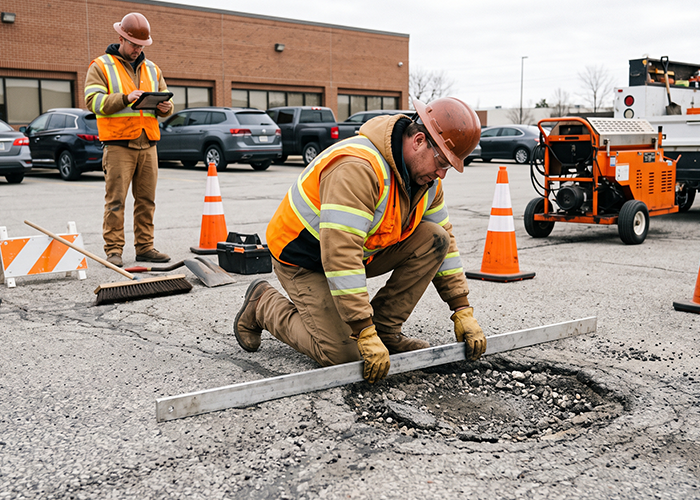
Infrared repair is worth considering when the damage is localized and the surrounding asphalt is still in fair condition. It can be especially helpful when a property owner wants to repair a problem without removing a large pavement section.
The method also suits areas where access must be restored quickly. A crew can often complete several small repairs with less cutting, hauling, and cleanup than a traditional removal method would require.
A professional inspection remains important. Choosing infrared technology only because it appears fast may lead to disappointing results if the true problem lies below the asphalt.
The following conditions often make a site a good candidate:
- The pavement base feels stable.
- Damage is limited to a small area.
- The surrounding asphalt can still be heated and reworked.
- There is no active water problem beneath the patch.
- The repair does not require deep excavation.
- The area can be cleaned and dried.
- Traffic can be controlled while the asphalt is heated and compacted.
Each repair should be judged on its own condition. Two potholes that look similar from above may have very different causes below the surface.
When Should Infrared Repair Not Be Used?
Infrared technology cannot solve every asphalt problem. It works within the existing pavement, so the material beneath that pavement must be able to support the repair.
Large areas of alligator cracking often point to base failure, poor drainage, or repeated heavy loading. Heating the surface may improve its appearance for a short time, but the pattern can return because the underlying cause remains.
Deep potholes can present the same issue. If the base has washed away or become soft, the failed material must be removed and the foundation rebuilt before new asphalt is placed.
Infrared repair may not be the right choice when:
- The subgrade or aggregate base has failed.
- Water is moving beneath the pavement.
- The area has widespread fatigue cracking.
- The asphalt is badly contaminated.
- The pavement is too thin or deteriorated to rework.
- Large sections require full-depth replacement.
- Tree roots or underground utilities are causing movement.
A trustworthy contractor should explain these limits. Recommending a deeper repair when it is needed can save the property owner from paying for the same surface problem twice.
What Are the Benefits of Infrared Asphalt Repair?
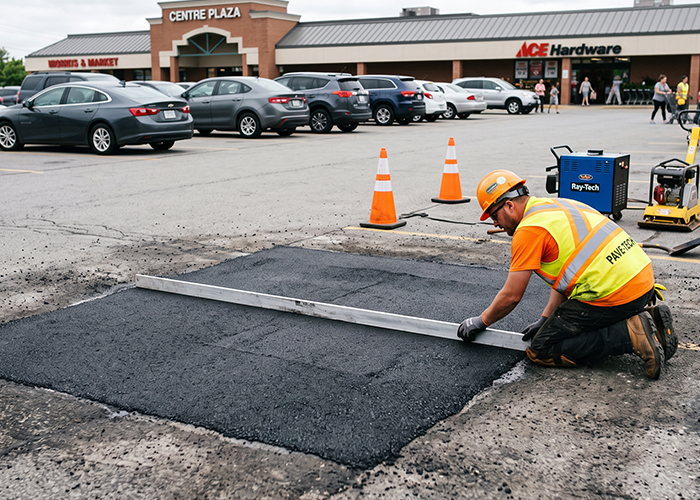
Infrared pavement patching has several practical benefits. Its value comes from how heat, reused pavement, new material, and compaction work together.
It Can Create a Close Bond
Traditional cut-and-fill patches have defined edges. These cold joints can become weak points if they are not sealed and compacted well.
Infrared repair heats the damaged area and part of the pavement around it. This allows the old and new asphalt to be worked together across the patch boundary.
The finished repair may have less of a visible seam. A close edge bond also helps limit routes through which water can enter.
It Reuses Existing Asphalt
Much of the existing asphalt can remain in place and become part of the finished repair. Only loose, contaminated, or badly failed material must be removed.
Fresh asphalt is normally added as needed, but the repair may require less new material than full removal and replacement. Less waste may also need to be hauled away.
Research supported by the New Jersey Department of Transportation and the Federal Highway Administration found that preheating can improve bonding between patch material and existing pavement. The same research examined the use of recycled asphalt pavement in pothole repair.
It Can Reduce Property Disruption
Saw cutting, excavation, loading, and hauling take time. Infrared repair can reduce some of these tasks when conditions are suitable.
Smaller work zones may be possible, and less heavy removal equipment may be needed. This can be useful at active shopping centers, office properties, schools, communities, and industrial sites.
Traffic still has to be controlled during the work. Once the patch has cooled enough, however, the area can often return to use without a long curing period.
It Produces a Smooth Finish
The heated material can be graded and compacted to match the nearby pavement. This is useful when the damaged area causes a rough ride or creates a trip hazard.
A smooth transition also makes it easier to sweep, plow, stripe, and maintain the pavement. It may improve drainage when a shallow dip has been trapping water.
The final appearance depends on the age of the existing asphalt. A new patch can look darker at first, even when the repair is level and properly finished.
It Can Lower Material Waste
Conventional removal creates broken asphalt that must be loaded, transported, and processed or disposed of. Infrared repair leaves much of that material at the work site.
Using less new asphalt and hauling less waste can reduce the number of truck trips tied to a repair. It may also lower material and disposal costs.
The total cost still depends on the number of repairs, their size, site access, traffic control, and travel time. Infrared technology is efficient, but it is not automatically the least expensive choice for every project.
How Does Infrared Repair Compare with Other Methods?
Property owners usually choose among cold patching, conventional hot-mix patching, full-depth repair, and infrared repair. Each method serves a different purpose.
Cold Patch vs Infrared Repair
Cold patch material is useful for emergencies and temporary repairs. It can be stored, transported, and installed without an infrared heater or a supply of hot asphalt.
This convenience makes cold patching helpful during bad weather or when an immediate hazard must be filled. Still, the material may not form the same bond as a well-installed heated repair.
Infrared repair takes more equipment and training. When site conditions permit, it can provide a smoother and more lasting result for localized surface damage.
Saw-Cut Patching vs Infrared Repair
Saw-cut patching removes the damaged asphalt within a defined shape. Fresh hot mix is placed in the opening and compacted against the cut edges.
This method is useful when failed material must be fully removed. It can also reach greater depths than a surface infrared repair.
Infrared repair creates less debris and avoids some hard, cold edges. However, saw-cut patching may be the better choice when the damage is too deep for heating and reworking.
Full-Depth Repair vs Infrared Repair
Full-depth repair removes the asphalt and damaged base. The foundation is rebuilt before new pavement is installed.
This is the proper response to structural failure, widespread alligator cracking, and deep movement. It takes more labor and material because the problem extends beyond the surface.
Infrared technology is less intrusive, but it should not be used as a substitute for necessary base work. A lasting repair depends on matching the method to the actual failure.
What Can Affect the Quality of an Infrared Repair?
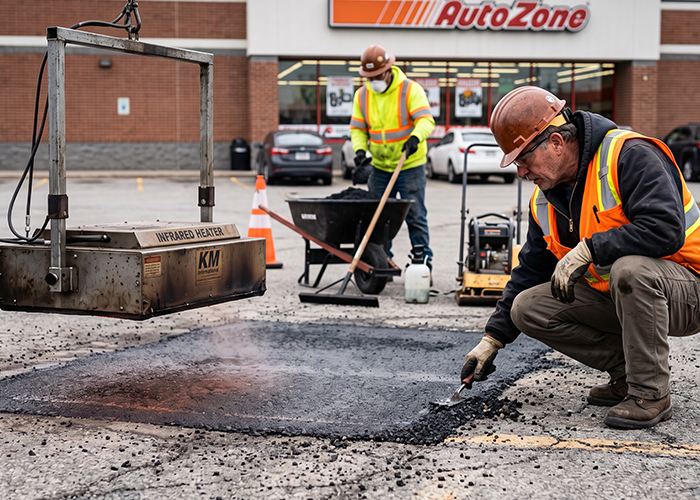
The machine does not complete the repair by itself. Surface preparation, temperature control, material handling, and compaction all affect the final result.
Moisture is a common concern. The area should be dry enough for even heating, and any source of recurring water should be examined.
Excess heat is another risk. If the asphalt binder is burned, the repair can become brittle and lose strength. The operator must monitor the surface rather than rely only on a fixed timer.
Poor mixing may leave pockets of old and new material. Weak compaction can also leave air voids that allow water to enter and the patch to loosen.
A quality repair depends on several details:
- Correct diagnosis of the damage
- A clean and reasonably dry surface
- Even heating across the repair area
- Adequate heating depth
- Removal of loose or contaminated material
- Proper use of rejuvenating products
- Thorough blending of old and fresh asphalt
- Correct grading for drainage
- Edge-first compaction
- Enough compaction before the mix cools
Skipping any of these steps can reduce the service life of the patch. Infrared technology gives a trained crew useful control, but it does not excuse poor workmanship.
Can Infrared Asphalt Repair Be Done in Cold Weather?
Infrared equipment can extend the working season because it supplies heat directly to the pavement. This can make certain repairs possible when standard hot-mix work would be difficult.
Cold weather still affects the process. The surface takes longer to heat, and the softened asphalt loses heat faster after the unit is removed. Wind may shorten the time available for raking, grading, and compaction.
Snow, ice, and trapped moisture can also delay the job. The pavement must be prepared correctly before heating begins.
For that reason, year-round capability should not be confused with identical working conditions in every season. An experienced contractor will adjust the heating cycle, crew timing, and repair plan to fit the weather.
How Long Does an Infrared Asphalt Repair Last?
There is no single service-life figure that applies to every infrared patch. Its performance depends on the cause of the damage, base condition, drainage, traffic, weather, materials, and installation quality.
A properly completed repair on a stable base can provide a durable solution to localized surface failure. A patch placed over weak support may fail again, regardless of how well its surface was finished.
Ongoing pavement care also matters. Crack sealing, drainage correction, sealcoating, sweeping, and timely repairs can reduce the stress placed on both the patch and the surrounding asphalt.
Property owners should inspect repaired areas during routine pavement checks. New cracks, sinking, standing water, or movement may signal a larger issue that needs attention.
What Should You Ask an Infrared Repair Contractor?
The right questions can help you understand whether the recommended work addresses the actual problem.
Ask the contractor:
- What caused the pavement to fail?
- Is the base beneath the damage still stable?
- Why is infrared repair suitable for this area?
- How much surrounding pavement will be heated?
- Will failed or contaminated material be removed?
- Will a rejuvenating agent or fresh asphalt be added?
- How will the patch be graded and compacted?
- When can vehicles use the area again?
- Does drainage need to be corrected first?
- What maintenance will the repaired area need?
Clear answers are a good sign. Be cautious if a contractor promises that infrared heat can fix every pothole, crack, or sunken area without first checking what lies below the surface.
Better Repairs, Longer-Lasting Pavement
Not every pavement problem calls for a complete replacement.
Infrared asphalt repair provides a targeted solution that restores damaged areas, minimizes unnecessary removal, and helps extend the life of existing pavement.
Ready to give damaged pavement a second life? Call us at 704-227-0468 or contact us online for a free assessment.
Related Articles:
- Infrared Oil Spot Repair: the Smart Way to Restore Asphalt Pavement
- How Humidity Affects Asphalt Deterioration and Shortens Pavement Life
- Why Is Sealcoating Asphalt Pavement Or Driveway Necessary?